MySQL Logs
All DML operations (INSERT/UPDATE/DELETE) are first completed in the Buffer Pool
redo log
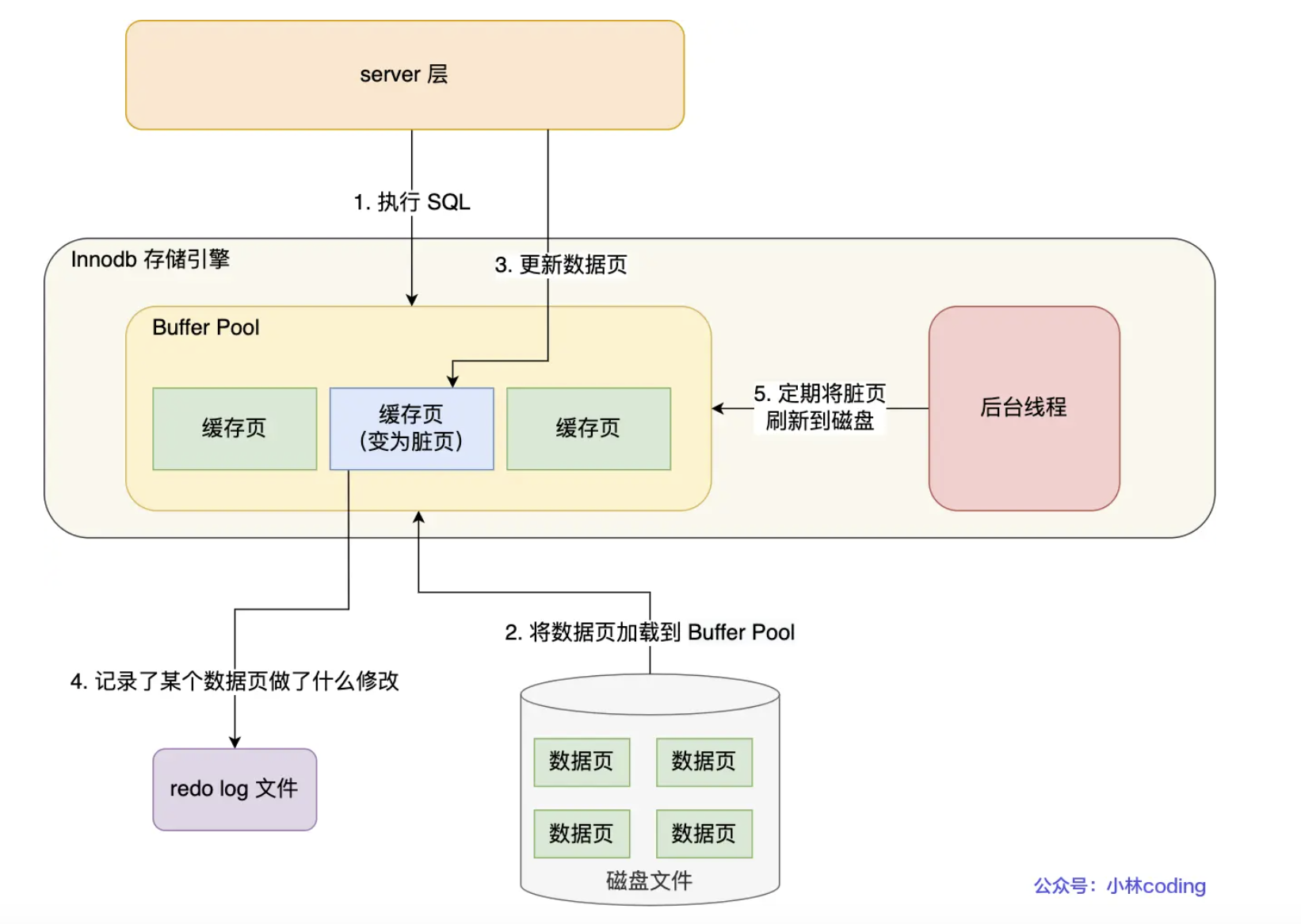
- Implements transaction durability. redo log is flushed to disk first, then dirty pages are flushed to disk
Physical Storage Characteristics
File Structure
- Composed of fixed-size files (such as
ib_logfile0,ib_logfile1) - Circular write (ring buffer) design
- Physical writes are always appended to the end of the file
- Composed of fixed-size files (such as
Write Mode
| |
Write-Ahead Logging (WAL):
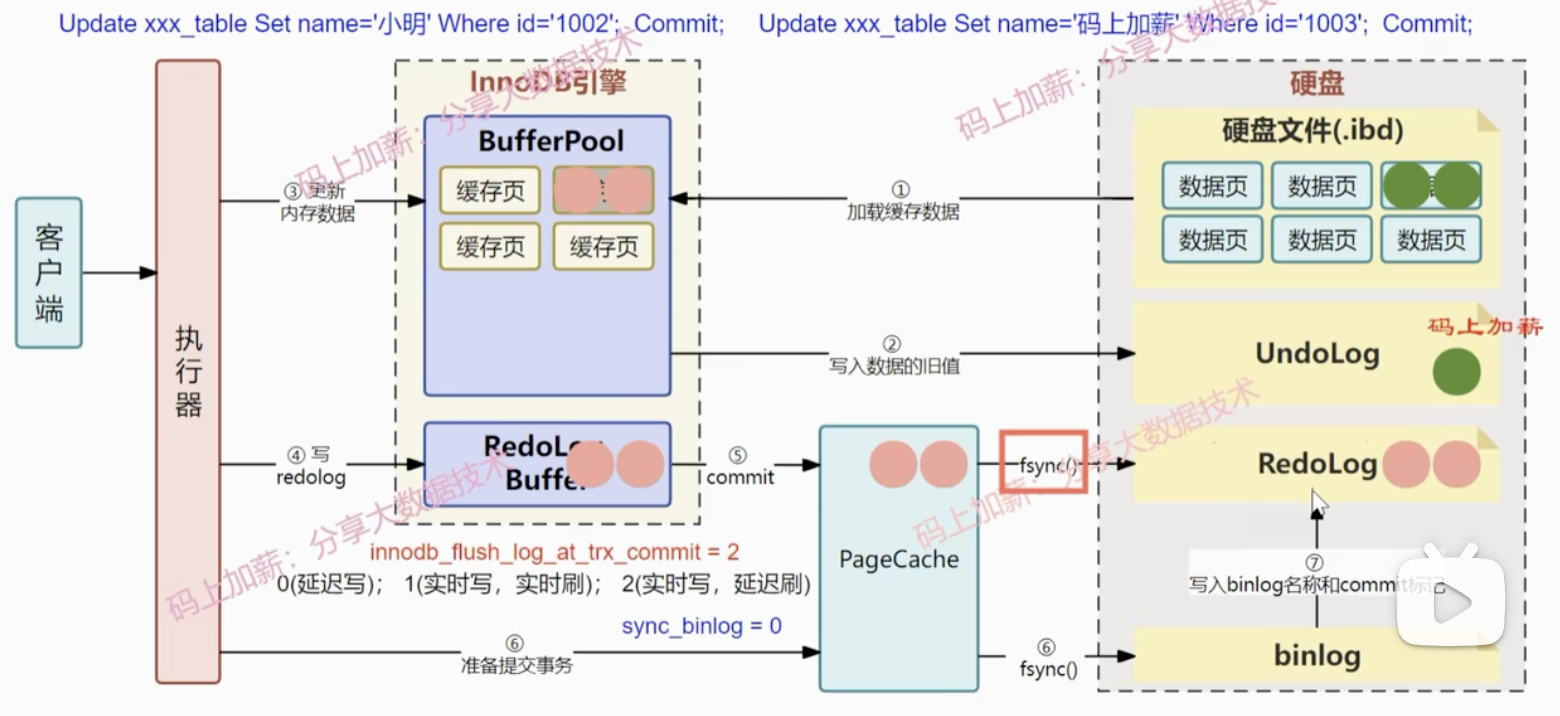
- Update data pages in Buffer Pool, these data pages become dirty pages.
- Write physical changes to data pages (such as “page number X, offset Y write data Z”) sequentially to redo log buffer.
- When executing COMMIT, behavior is determined by configuration parameter innodb_flush_log_at_trx_commit (usually default value is 1)
| Parameter Value | Behavior | Durability Guarantee |
|---|---|---|
| 1 (default) | 1. Write PageCache 2. Immediate fsync() flush to disk | Complete durability |
| 0 | Batch write + flush to disk every second | May lose 1 second of data |
| 2 | Write PageCache but delay flush to disk | Only guarantees OS doesn’t crash |
- Asynchronous dirty page flush to disk, background threads flush data from BufferPool to hard disk
undo log
- Implements transaction rollback, ensures transaction atomicity
- Combined with ReadView implements MVCC, maintains version chain for records
Binlog
Basic Concepts
Binlog (Binary Log) is a binary log implemented at MySQL Server layer, recording all SQL statements that modify data (logical log), written when transactions commit.
Core Features
Recorded Content:
- All DDL (CREATE/ALTER etc.) and DML (INSERT/UPDATE etc.) statements
- Stored as events, including metadata like execution time, error codes
Comparison with Redo Log:
Binlog Redo Log Layer Server layer InnoDB engine layer Type Logical log (SQL statements) Physical log (page modifications) Purpose Master-slave replication/data recovery Crash recovery Three Formats:
- STATEMENT: Records original SQL (may cause master-slave inconsistency, if slave execution environment differs slightly from master, may lead to data inconsistency)
- ROW: Records row data changes (default recommended)
- MIXED: Mixed mode
Master-Slave Replication
server-id is the unique identifier for MySQL instances, both master and slave must have it and cannot be duplicated, used to distinguish different nodes.
Master opens a thread to handle binlog distribution, called Binlog Dump thread.
Slave has two key threads: one is I/O thread, responsible for establishing connection with master, requesting master binlog, then writing to its own relay log; the other is SQL thread, reading content from relay log written by I/O thread, executing SQL statements on slave to update data.
Master Parameters
log-bin enables binary logging, binlog-format sets log format
Slave Parameters
- Master_Host is the master’s IP
- Master_User is the user
- Master_Port is the port
- Master_Log_File is the master binlog filename